
Climbing the Mountain and Learning How to Serve G-d

This is the best thing I have ever DONE for me, my family & friend's and my community.
This might sound like an over statement, and I still stand by it with all my heart. You get the ability to change your destiny, and others.
Some prayers change your whole day. Not because they are dramatic, but because they are real.
You wake up. You carry your body. You carry your thoughts. You try to keep G-d in your actions from the moment you open your eyes. Then you choose one more step. You go for a small climb. You go up the mountain. You pray.
That climb is work. Sometimes you feel tired. Sometimes you do not want to go. But you already know the secret. When you go up and pray, you come back with more energy. You feel lighter. You feel happier. The effort turns into fuel.
This is exactly what worshipping G-d is all about. It is about the journey of becoming free, step by step.
Fear can actually be excitement
I noticed something about fear. Sometimes it is not fear of danger. Sometimes it is fear of something good.
You are about to grow. You are about to step into a new level. The body feels that edge and calls it fear. The soul feels that edge and calls it excitement.
That is why the mountain feels so powerful. Your body says, this is hard. Your soul says, this is growth. And when you come back down, you feel joy because you crossed that line.
I see this a lot with artists too. When someone is about to create something important, they often feel dread first. Not because the dream is wrong, but because it matters. The fear is not proof you should stop. Sometimes it is proof you are close to something real.
Sometimes the world will not change right away
In the Torah, G-d hardens Pharaoh’s heart. That means Pharaoh keeps refusing, even after seeing signs. It teaches a deep lesson.
Sometimes you can be doing the right thing and still not see quick results. Sometimes life keeps saying no. Not because your mission is wrong, but because your mission needs strength. It needs purity. It needs patience.
So what do you do?
You fall in love with the journey. You keep going because serving G-d matters. You do not do it only for a reward. You do it because it is the truth.
Jewish practice turns freedom into real life
The Bible does something powerful. Before the big miracles are finished, G-d gives mitzvot. He gives daily actions that shape a person.
Freedom is not only leaving Egypt. Freedom is learning how to live.
Here are a few examples that connect beautifully to this Parsha and to the mountain experience.
Tefillin
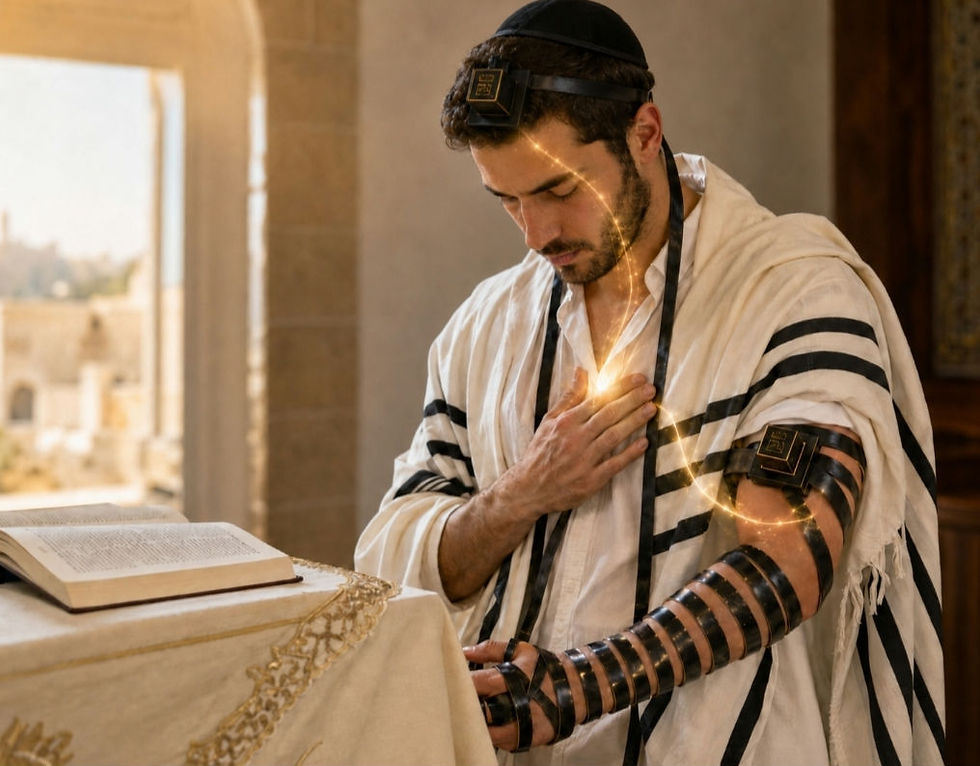
Tefillin connects the head and the hand. Your thoughts and your actions.
When you put on tefillin, you are saying with your body: I belong to G-d. My mind is not owned by fear. My hands are not owned by pressure. My life is not owned by Pharaoh. I choose a higher purpose.
Tzitzit and living tefillin all day
The Torah! and in Parshat Bo gives the mitzvah of tefillin as a sign on the hand and between the eyes. Later, the Torah gives tzitzit as a daily reminder that surrounds the body.
Tefillin is the covenant tied to the arm and the mind. Tzitzit is the covenant that moves with you everywhere. In a simple way, tefillin is the focused moment of binding, and tzitzit is the ongoing reminder that keeps the Torah wrapped around your life.
That is why tzitzit can be understood as a way of fulfilling the inner goal of tefillin throughout the day. Tefillin sets the direction. Tzitzit helps you keep it.
Shema and prayer
Shema reminds you that G-d is One. It pulls your heart back to calm and clarity.
Prayer is standing in G-d’s presence. It is remembering who you are and why you are here. The mountain is just a place. The real climb is inside you.
Time becomes holy
In Parshat Bo, G-d gives the Jewish people their calendar. He tells them this month is for you.
That means the first thing we redeem is time. Your day is not just random. Your week is not just survival. Time becomes meaningful. When you protect your time for prayer, you stop drifting.
Chametz and matzah
Chametz is dough that puffs up. Matzah is simple bread.
One way to understand it is like this. Chametz is the part of us that wants to inflate, to delay, to control everything. Matzah is the part of us that says: I will move with faith even if I do not feel fully ready.
Your climb is matzah energy. You go even when you feel tired. And then the light meets you there.
Feeling the Ten Sefirot in the body
One of the most meaningful parts of prayer for me is that it is not only thoughts. It is felt. G-d created the soul and also the body, and the body can become a map for spiritual awareness.
When I put on tefillin and I pray, I can feel the Ten Sefirot moving through me like a living structure.
Keter feels like a quiet crown above the mind. A simple humility that says, I am here to serve.
Chochmah feels like a sudden flash of insight. A clean spark that comes without force.
Binah feels like understanding settling in. The spark becoming clear, like it is being built into something stable.
Chesed feels like warmth and openness in the chest. The desire to give and to love.
Gevurah feels like strength and boundaries. The ability to hold back, to focus, to choose.
Tiferet feels like balance and beauty. When kindness and discipline meet, and the heart becomes straight.
Netzach feels like endurance in the legs. The push to keep walking, keep climbing, keep going.
Hod feels like gratitude and surrender. The recognition that I am not the source, only a vessel.
Yesod feels like connection. The feeling of alignment, like everything is linking together.
Malchut feels like presence in the feet and in the voice. Bringing the holiness down into the world. Taking what I received in prayer and turning it into action, speech, and reality.
So the mountain climb is not only exercise. It is a full body way of serving G-d. It is spiritual alignment from head to hand to heart to feet.
Firstborn, priesthood, and the lesson of responsibility
Parshat Bo brings in the holiness of the firstborn. In the beginning, the eldest of each family had a special role and spiritual responsibility. The firstborn represented the strength of the home, the leadership, the continuity.
Later, after the sin of the golden calf, that role shifted. The priesthood became centralized in the Kohanim from the tribe of Levi. That was not only a punishment. It was also a lesson.
Spiritual leadership is a gift, but it is also a test. When a person is not ready, the responsibility can break them. When a nation is not ready, the role must be protected so holiness is not turned into ego or chaos.
This returns us to Rabbi Nachman’s idea. Deep truths and high spiritual roles can only be carried when the vessel is ready. Until then, the work is to build the vessel with daily faithfulness.
The body is not your enemy
Prayer helps you notice your body, but it also helps you remember something bigger.
Your body is not the boss. It is the tool. When your body serves your soul, it becomes holy.
That is why prayer, tefillin, and tzitzit are so powerful. They do not ignore the body. They guide it.
We do not know how we will serve G-d until we arrive there
Moshe says a sentence that can change your life.
We do not know how we will serve G-d until we arrive there.
This does not mean weakness. It means honesty.
You cannot demand to know everything before you start. You start walking, and you discover who you are along the way. You climb, and at the top you learn what you truly brought with you. Strength, tears, clarity, love, gratitude. You only find out once you arrive.
So here is the principle.
You do not need to know everything before you move. You move, and the knowing meets you on the road.
Helping other people move toward their dreams
This lesson also connects to my life mission and my work.
Many people do not fail because they lack talent. They fail because the path feels too hard before they even start. They want the dream, but they do not have the tools, the structure, the guidance, the community, or the plan.
So part of my service to G-d is helping people take the next step.
I cannot climb the mountain for them. No one can. Each person must walk their own path. But I can make the path easier. I can offer tools. I can reduce confusion. I can connect people to the right support. I can help them build the vessel so when they arrive, they are ready.
We keep limited spots because real care needs focus. If you take on too many, you stop serving and you start managing. And I want this to stay pure.
My goal is not to promise instant results.
My goal is to strengthen the journey and help people keep walking until they arrive.
A birthday blessing
And since it is your Hebrew birthday, here is a blessing that matches this whole message.
May your fear turn into healthy excitement.
May your effort turn into real energy.
May your climb turn into inner peace.
May your tefillin, your tzitzit, your Shema, and your prayer give you a clear path, so that you return from the mountain with light and bring that light into your whole day.
And may you keep choosing the journey even when results feel delayed, because the journey itself is where G-d meets you.


Comments