Tefillin, the Body, and the Pathway of the Soul

Updated: Jun 23
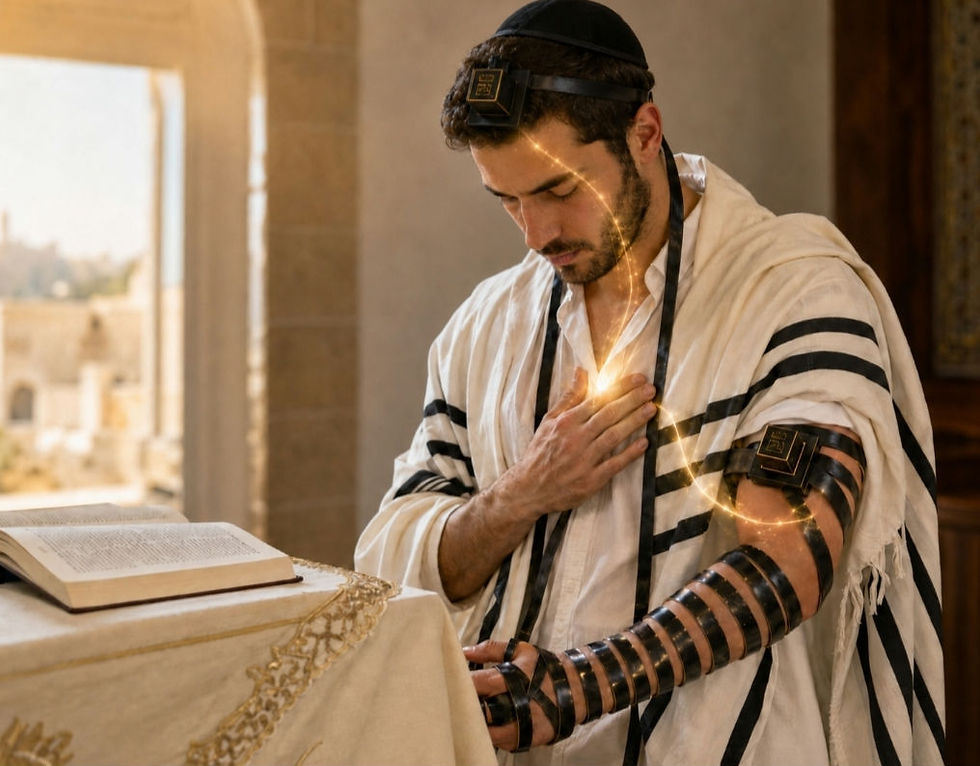
Every morning, when I wrap Tefillin, I am not just putting leather on my arm.
I am entering a conversation.
A conversation with G-d.
A conversation with my own soul.
A conversation with every Jew who wrapped before me, from the desert, to exile, to Jerusalem, to today.
Tefillin is one of the deepest mitzvot because it takes something spiritual and places it directly onto the body. Torah does not leave holiness floating in the clouds. Torah brings holiness into the arm, into the head, into the heart, into action.
The Torah says:
“וקשרתם לאות על ידך והיו לטטפת בין עיניך”
“You shall bind them as a sign upon your arm, and they shall be as frontlets between your eyes” (Devarim 6:8).
The Torah repeats this idea again in Devarim 11:18, and it appears earlier in the Exodus passages, where Tefillin is connected to remembering that Hashem took us out of Egypt (Shemot 13:9, Shemot 13:16).
That itself is powerful.
Tefillin is not only about belief.
It is about freedom.
Every day, we bind ourselves to G-d so we do not become slaves to fear, ego, confusion, impulse, or the noise of the world.
The arm Tefillin goes first. The head Tefillin comes after. The Gemara discusses the connection between the Tefillin of the arm and the Tefillin of the head, teaching that one must be careful not to interrupt between them (Menachot 36a).
That is not random.
First we bind action.
Then we crown thought.
First the hand says, “I will do.”
Then the mind says, “I will understand.”
This is the Jewish order of greatness. Naaseh v’nishma. We act, and through action, we become people who can hear.
The halacha teaches that the arm Tefillin is placed on the upper arm, opposite the heart, while the head Tefillin is placed above the forehead, aligned in the place that corresponds to “between the eyes” (Shulchan Aruch, Orach Chaim 27:1, 27:9).
So the mitzvah creates a holy line.
Arm.
Heart.
Mind.
Action.
Emotion.
Consciousness.
This is where I find a fascinating parallel with Chinese medicine. Traditional Chinese medicine speaks about channels in the body, often called meridians, through which life energy is understood to flow. Acupuncture works with points along these channels to help bring balance and alignment. Modern medical sources describe acupuncture as a practice within traditional Chinese medicine that stimulates specific points on the body, while also cautioning that it should be understood carefully and responsibly (National Center for Complementary and Integrative Health, “Traditional Chinese Medicine: What You Need To Know”).
Now I want to be clear.
Torah does not need acupuncture to prove it.
Tefillin does not need outside validation.
The mitzvah stands because G-d commanded it.
But when we see another ancient system also paying attention to pathways in the body, to the arm, to the head, to the heart, it should make us pause. Not to mix religions. Not to invent halacha. But to notice something beautiful.
The human body is not random.
The soul is not floating outside the body.
The body is a map.
And mitzvot are the divine instructions for how to walk that map.
The arm strap begins near the heart, and the hand becomes wrapped in covenant. In Chinese medicine, the inner arm is associated with pathways connected to the heart and protective emotional systems. In Torah language, we would say something deeper.
The heart must be guarded.
The heart must be trained.
The heart must be softened.
The heart must be made loyal.
That is why we say in the first paragraph of Shema:
“ואהבת את ה׳ אלקיך בכל לבבך”
“You shall love Hashem your G-d with all your heart” (Devarim 6:5).
Tefillin turns love into discipline.
Not the kind of discipline that crushes a person.
The kind that saves him from being ruled by whatever emotion screams the loudest that morning.
When I wrap Tefillin, I am saying:
My arm is not ownerless.
My strength is not ownerless.
My desires are not ownerless.
My business is not ownerless.
My creativity is not ownerless.
My anger is not ownerless.
My heart belongs to G-d.
Then comes the head Tefillin.
The Rambam writes that the holiness of Tefillin is very great. As long as Tefillin are on a person’s head and arm, the person is humble, G-d fearing, not drawn into empty laughter and idle speech, and does not think evil thoughts. Instead, the person turns his heart toward words of truth and righteousness (Rambam, Mishneh Torah, Hilchot Tefillin, Mezuzah, and Sefer Torah 4:25).
That line from the Rambam hits hard.
Because Tefillin is not decoration.
It is a spiritual technology of humility.
The head Tefillin sits over the place of thought. It tells the mind:
You are powerful, but you are not king.
G-d is King.
Your ideas matter, but they need truth.
Your imagination matters, but it needs holiness.
Your ambition matters, but it needs service.
In a world where people worship their own thoughts, Tefillin reminds us that the mind is holy only when it bows to something higher than itself.
This is why Tefillin is connected to memory.
We remember the Exodus.
We remember that G-d took us out with a strong hand.
We remember that freedom without responsibility becomes another Egypt.
A person can leave Pharaoh and still be enslaved to himself.
That is why every morning we wrap.
Because the Exodus did not only happen once.
It happens every day.
Every day I must leave my private Egypt.
Fear is Egypt.
Confusion is Egypt.
Addiction is Egypt.
Ego is Egypt.
Laziness is Egypt.
Hopelessness is Egypt.
Tefillin says:
Bind the arm.
Crown the mind.
Return the heart.
Walk out.
The straps also move downward toward the hand and fingers. This matters deeply. Judaism never leaves spirituality in meditation alone. The hand must be involved. The fingers must be involved. The world must be touched differently because of what I believe.
A Jew cannot say, “I love G-d,” and then let his hands harm people.
A Jew cannot say, “I believe,” and then let his business become dishonest.
A Jew cannot say, “I pray,” and then let his actions become cruel.
The Tefillin on the arm tells us that faith must enter the muscles.
Faith must enter the work.
Faith must enter the contract.
Faith must enter the way we speak to family.
Faith must enter how we spend money.
Faith must enter how we build companies.
Faith must enter how we forgive.
Faith must enter how we fight.
Faith must enter how we lead.
This is why Tefillin is a daily act of kingship. Not kingship over others. Kingship over the self.
Pirkei Avot teaches:
“איזהו גיבור? הכובש את יצרו”
“Who is strong? One who conquers his inclination” (Pirkei Avot 4:1).
That is the real warrior.
Not the person who controls everyone else.
The person who can wake up, wrap his arm, lower his ego, focus his mind, and say:
Today, I will serve.
Today, I will build.
Today, I will not be dragged by every feeling.
Today, I will remember who I am.
There is also a mystical layer.
The Zohar and later Kabbalistic sources speak about Tefillin as drawing holiness onto the person. The Tefillin of the arm and the Tefillin of the head correspond to different levels of inner service. The arm Tefillin is hidden, close to the heart. The head Tefillin is revealed, like a crown.
That is life.
Some holiness must be private.
Some holiness must be visible.
The private holiness is the heart work no one sees.
The visible holiness is how a person walks in the world.
If the hidden part is fake, the revealed part becomes performance.
If the hidden part is real, the revealed part becomes light.
This is why I believe Tefillin is a full body teaching.
It is Torah on the skin.
Memory on the arm.
Purpose on the head.
Covenant on the hand.
A person becomes a walking Mishkan, a moving sanctuary.
And when we compare it gently to Chinese medicine, we can say this:
Chinese medicine notices that the body has pathways.
Torah reveals what those pathways are ultimately for.
Not just health.
Holiness.
Not just balance.
Covenant.
Not just calm.
Closeness to G-d.
That is the key difference.
The goal of Tefillin is not simply to feel centered, although it can center you.
The goal is not simply to calm anxiety, although it can calm the heart.
The goal is not simply to focus the mind, although it can sharpen the mind.
The goal is deveikut.
Attachment to Hashem.
To take the wild electricity of being human and plug it into the Source.
That is why this mitzvah is so powerful for a person building, leading, creating, fighting, healing, and trying to become who G-d made him to be.
Because without alignment, power becomes danger.
Without humility, intelligence becomes arrogance.
Without holiness, creativity becomes ego.
Without covenant, freedom becomes chaos.
Tefillin brings the pieces back together.
The arm says:
I will act with holiness.
The heart says:
I will love with discipline.
The mind says:
I will think with truth.
The hand says:
I will build with purpose.
And the soul says:
I am not alone.
I am bound to G-d.
I am bound to my people.
I am bound to the mission.
Every morning, the leather wraps around the body, but really, it is wrapping around the day.
Before the phone.
Before the meetings.
Before the pressure.
Before the noise.
Before the world tells me who I am.
Tefillin lets the Torah tell me first.
You are a servant of G-d.
You are free.
You are responsible.
You are loved.
You are commanded.
You are capable.
And that is the blessing.
Because the world wants us scattered.
Tefillin gathers us.
The world wants our mind in one place, heart in another, hands somewhere else.
Tefillin reunites us.
The world says, “Follow every feeling.”
Tefillin says, “Train the heart.”
The world says, “Your thoughts are everything.”
Tefillin says, “Place your thoughts under Heaven.”
The world says, “Freedom means no limits.”
Tefillin says, “Freedom means choosing the right bond.”
That is the secret.
The straps do not imprison us.
They release us.
Because when a person is bound to G-d, he is no longer owned by Pharaoh.
Not the Pharaoh of Egypt.
Not the Pharaoh of fear.
Not the Pharaoh of ego.
Not the Pharaoh of the world.
He walks out every morning with a strong hand, a humble mind, and a heart ready to serve.
That is Tefillin.
A mitzvah.
A memory.
A map.
A crown.
A daily Exodus.
A pathway from the body to the soul, and from the soul back to G-d.


mình có lần lướt đọc mấy trao đổi trên mạng شيخ روحاني thì thấy nhắc nên cũng tò mò mở ra xem thử cho biết. mình không tìm hiểu sâu chỉ xem qua trong thời gian ngắn để quan sát bố cục cách sắp xếp جلب الحبيب các mục và trình bày nội جلب الحبيب dung tổng thể. cảm giác là các phần được trình bày khá gọn, các hurentest berlin mục rõ ràng Huren Berlin nên đọc lướt cũng không bị rối với mình như vậy là đủ để nắm tin cơ bản rồi. جلب الحبيب
👍
The detail about binding action before thought really stood out to me — I never considered how that order might apply to something as physical as wrapping the leather before the mind catches up. — Iron Nest Guide multiplayer page
The image of tefillin as a conversation spanning from the desert to today really resonates—it’s a physical anchor for the soul’s dialogue. I’ve been reflecting on that same connection lately, and I’ve been using a guided daily practice that deepens the wrapping ritual. https://aiphototemplate.com
The image of tefillin as a conversation spanning generations really hit me—it turns a daily ritual into a living chain. I've been reflecting on how that physical act of binding reshapes my own awareness, and I've been using a guide that breaks down the deeper kavanah behind each wrap. https://banana-nano.co
The image of tefillin as a conversation with every Jew who wrapped before you really lands—it turns a physical act into a lineage. I've been using a daily guide that frames the wrapping as a somatic prayer, and it's deepened that exact dialogue. https://music-generatorai.com